


AAC for Children: Supporting Communication, Confidence, and Daily Life

When a child cannot rely on speech, people may mistake quiet for “nothing to say.” That misunderstanding can be painful. Children have ideas, preferences, worries, jokes, questions, and opinions long before they can express them clearly with spoken words.
Augmentative and Alternative Communication, often called AAC, gives children other ways to communicate. AAC can support speech, replace speech when needed, or give a child a reliable way to be understood while spoken language develops. For many children and families, it opens the door to fuller participation at home, at school, and in the community.

What AAC means for children who struggle with speech
AAC includes any tool, strategy, or system that helps a person communicate without relying only on spoken speech. The word “augmentative” means it adds to speech. The word “alternative” means it can serve as another way to communicate when speech is not available or reliable.
AAC can help a child say many kinds of things, such as:
What they want or do not want
How they feel
What hurts
What they noticed
Who they want to be with
What they are thinking about
When they need help or a break
This matters because communication is not only about requesting snacks or toys. A child also needs a way to protest, ask questions, share interests, make choices, and connect with others.
AAC for children can also reduce frustration. When a child has no clear way to say “stop,” “I’m scared,” or “I want more time,” behavior may become the message. AAC gives families and caregivers more ways to understand what the child is trying to communicate.
This post is for general education and support. For individual guidance, a speech-language pathologist, occupational therapist, teacher, or medical provider can help match AAC tools to a child’s needs.
Who can benefit from AAC
AAC can support many children, including children who speak some words. A child does not need to be completely nonspeaking to benefit. AAC may help when speech is hard to understand, inconsistent, tiring, or not available during stress.
Children who may benefit include those with:
Autism
Some autistic children use few or no spoken words. Others speak but lose access to speech when overwhelmed, tired, or anxious. AAC can offer a steady way to communicate across settings.
Cerebral palsy
A child with cerebral palsy may understand a great deal but have difficulty controlling the muscles needed for speech. AAC can help the child show what they know and take part in conversations.
Developmental delays
Children with delays may need more time and support to build language. AAC can give them a way to communicate while they continue learning.
Childhood apraxia of speech or other speech motor differences
Some children know what they want to say but cannot consistently plan and produce the sounds. AAC can lower pressure and support communication.
AAC does not “give up” on speech. Research and clinical experience suggest that AAC often supports language growth because it gives children more chances to practice communication successfully.

Presume competence and listen for meaning
One of the most important ideas in AAC is presume competence. This means starting with the belief that a child has thoughts, feelings, and the ability to learn, even when their body, speech, or behavior makes communication difficult.
Presuming competence does not mean pretending a child can do every task independently. It means giving access, teaching with respect, and not limiting a child’s communication to what adults assume they understand.
A child may show understanding in subtle ways:
Looking toward a person or object
Reaching, pointing, or moving their body
Changing facial expression
Vocalizing
Repeating an action
Avoiding something
Calming when offered the right support
Families and caregivers can build from these signals. For example, if a child turns away from a food, an adult might model “no,” “all done,” or “don’t like” on the child’s AAC system. The goal is not to force a response. The goal is to show the child, “Your message matters, and there is a way to say it.”
Every child deserves access to communication that goes beyond guessing.
AAC tools can be simple or high-tech
AAC is not one single device. It is a range of tools and strategies. Many children use more than one type, depending on the place, activity, and day.
No-tech AAC uses the body
No-tech AAC does not require materials or electronics. It may include:
Gestures
Facial expressions
Eye gaze
Pointing
Sign language
Body movements
Yes and no signals
A clear yes or no system can be powerful. Some children use a thumbs-up, head turn, eye look, or touch response. The key is consistency and making sure communication partners understand the signal.
Low-tech AAC uses simple materials
Low-tech AAC includes tools that do not need batteries or screens. These may include:
Picture cards
Choice boards
Communication books
Alphabet boards
Core word boards
Visual schedules
Low-tech tools are often affordable, portable, and easy to place around the home. For example, a bathroom board might include “help,” “hurt,” “finished,” “wash,” and “towel.” A mealtime board might include “more,” “all done,” “different,” “drink,” and “like.”
High-tech AAC uses electronic systems
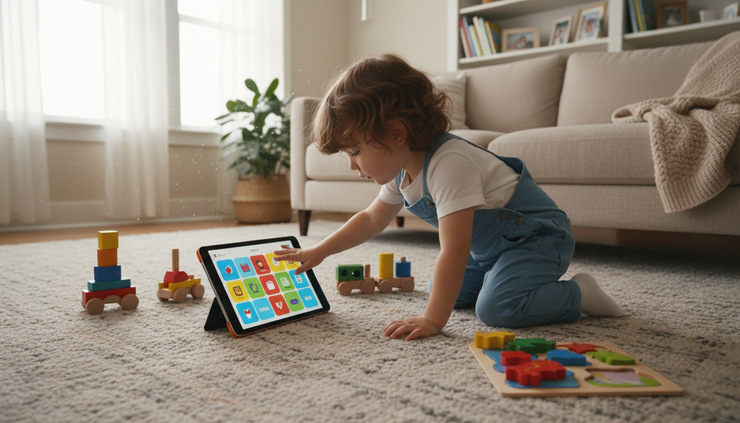
High-tech AAC includes speech-generating devices, tablets with AAC apps, switches, eye-gaze systems, and other electronic tools. These systems can speak messages out loud, store large vocabularies, and grow with a child over time.
High-tech tools can be especially helpful for children who need many words available, have limited hand movement, or communicate best through touch, switch access, or eye gaze.
How families can start using AAC in daily life
Getting started does not have to be perfect. AAC works best when it becomes part of real life, not a separate drill that only happens at a table.
Try these practical steps.
Start with meaningful words
Choose words the child can use across many situations. Words like “go,” “stop,” “more,” “help,” “all done,” “want,” “no,” “yes,” “look,” and “play” are useful throughout the day.
Model without pressure
Use the AAC system while speaking. For example, say “want more” while touching “want” and “more.” The child does not need to copy right away. Modeling shows how the system works.
Put AAC within reach
A communication board in a drawer cannot help during a hard moment. Keep AAC tools near meals, play areas, the car seat, the stroller, or bedtime routines.
Use everyday routines
AAC can fit into small moments:
During breakfast, model “eat,” “drink,” “more,” and “all done.”
During bath time, model “water,” “wash,” “stop,” and “cold.”
During play, model “go,” “again,” “my turn,” and “fun.”
During transitions, model “wait,” “help,” “finished,” and “next.”
Accept all forms of communication
If a child points, vocalizes, signs, or uses a device, respond to the message. AAC should add options, not take away the child’s natural communication.
Give enough wait time
Children often need extra time to process, look, reach, or select a message. Count silently before repeating a question. A slower pace can make communication feel safer.
Include the whole team
Parents, caregivers, teachers, therapists, siblings, and relatives can all use the same key words and responses. Consistency helps the child trust the system.

A supportive next step
AAC gives children access to more than words. It supports choice, safety, relationships, learning, and self-expression. A child who can say “no,” “I need help,” “that’s funny,” or “I miss grandma” has more control over daily life.
The best place to begin is with one routine and a few useful words. Model them often, respond warmly, and keep the tool close. Progress may look small at first, but each message builds trust.
When families presume competence and offer real communication options, children get a clearer path to being heard.


Comments